What Interior Materials Actually Hold Up in South Florida's Heat, Humidity, and Hurricane Season?
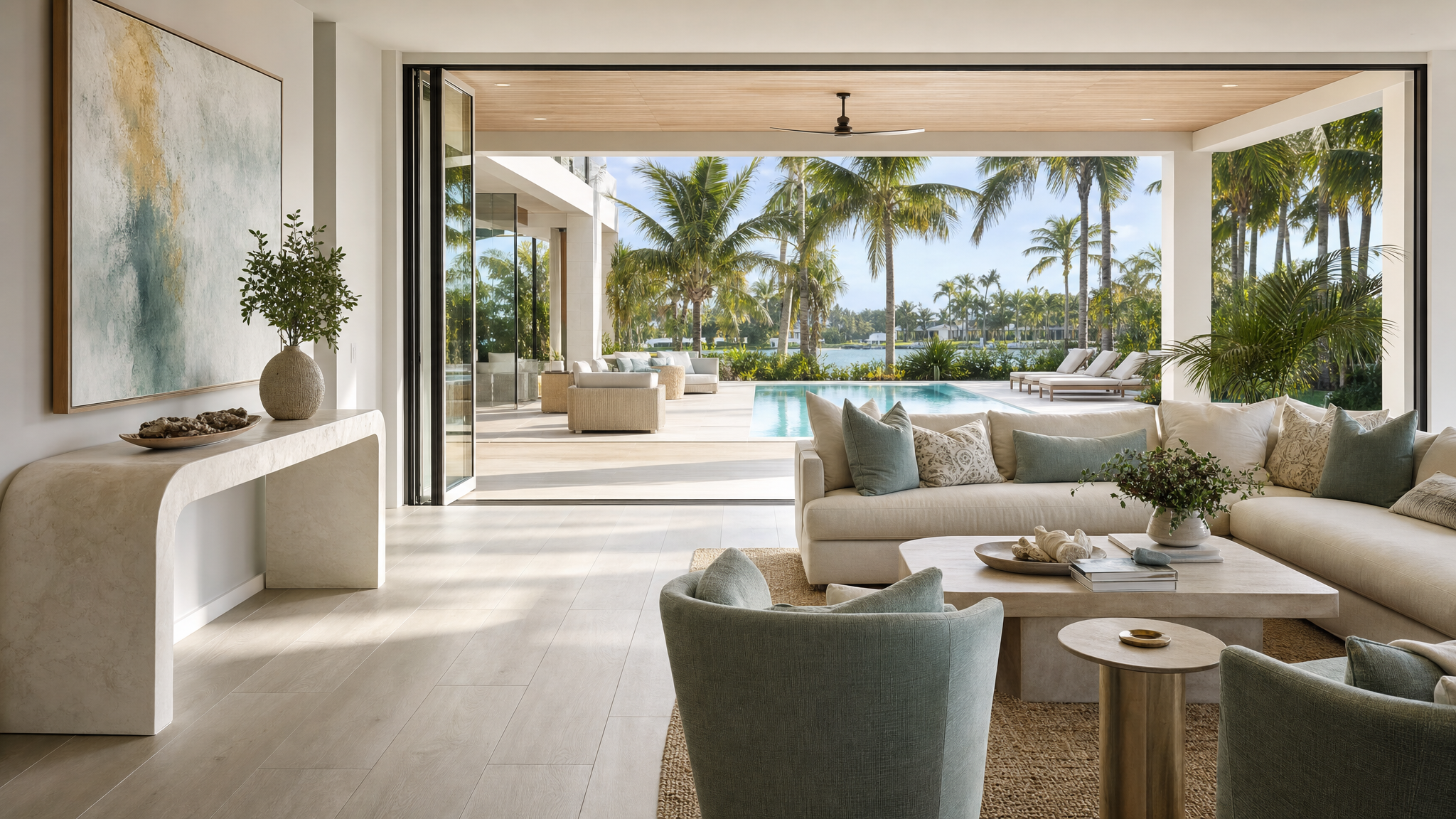
Every South Florida homeowner eventually asks some version of the same question: why does my beautiful new sofa look tired after eighteen months, or why did that hardwood floor start cupping the first rainy season? The answer usually isn't bad luck — it's material selection that didn't account for our climate. Storm-resistant interior design in South Florida isn't just about impact windows; it's about choosing flooring, upholstery, stone, and finishes engineered to survive salt air, near-constant humidity, intense UV exposure, and the pressure swings that come with hurricane season. Get this right during design, and your home looks better for longer with less maintenance. Get it wrong, and you're replacing "luxury" finishes every few years.
This guide breaks down what actually performs in a South Florida climate, what to avoid, and where a professional designer earns back their fee many times over by steering you away from expensive mistakes before they're made.
What Interior Materials Perform Best in South Florida's Heat and Humidity?
The best-performing interior materials in South Florida are non-porous, dimensionally stable, and resistant to moisture absorption — think porcelain tile, quartz, engineered hardwood, and solution-dyed performance fabrics. These materials resist warping, mildew, and UV fading far better than their traditional counterparts, which is why they've become the default specification in luxury coastal remodeling.
Here's how the major material categories break down:
Flooring. Solid hardwood expands and contracts with every humidity swing, which over a few South Florida seasons shows up as cupping, gapping, or buckling — even in climate-controlled homes, because door openings and outdoor living transitions let humidity in. Engineered hardwood, large-format porcelain tile (including realistic wood-look and stone-look planks), and honed natural stone are far more stable. If you love the look of hardwood, engineered constructions give you that warmth without the seasonal movement.
Countertops and stone. Quartz is non-porous, doesn't require sealing, and resists the heat and moisture exposure that come with indoor-outdoor kitchens. Natural stone can still work beautifully — but polished marble and limestone are higher-maintenance in a humid climate than a honed or leathered finish, which hides etching and moisture spotting.
Upholstery and textiles. Velvet, wool, and other heavy, absorbent fabrics trap moisture and heat and are prone to mildew in coastal humidity. Solution-dyed performance fabrics, high-quality linen blends, and performance cotton hold color and structure far longer, especially in rooms with pool or patio sightlines and lots of natural light.
Windows and glazing. Impact-rated glass is a code requirement in most South Florida jurisdictions, but it also shapes your interior design — thicker laminated glass affects light quality and window treatment options, so it should be considered during the design phase, not bolted on afterward.
Do I Need Hurricane-Rated Materials Inside My Home, Not Just at the Windows?
Yes — while building code focuses on the building envelope (impact windows, doors, and roofing), the interior finishes you choose determine how well your home recovers from storm season humidity spikes, power outages, and the general wear of a subtropical climate, so they deserve the same intentional planning.
A named storm is the dramatic scenario, but the everyday reality is more mundane and more relevant to your design budget: air conditioning that cycles constantly against outdoor humidity near 90%, salt-laden air along the coast that accelerates corrosion on hardware and fixtures, and intense UV exposure through large glass walls that fades fabric and finishes faster than almost anywhere else in the continental U.S. Specifying cabinet hardware, light fixtures, and metal finishes rated for coastal exposure — not just standard interior-grade — prevents pitting and discoloration within a couple of years. Storm-ready design also means thinking through backup power for essential systems, moisture-resistant backing behind cabinetry and millwork, and furniture placement that doesn't leave irreplaceable pieces directly beneath large glass expanses during outages.
How Much More Does Climate-Resistant Material Selection Add to a Design Budget?
Climate-appropriate materials typically add 10–20% to material line items compared to standard-grade options, but they usually cost less over a 10-year horizon because you avoid replacing warped flooring, mildewed upholstery, or corroded fixtures every few years. For a full-service luxury interior design project in Boca Raton or Delray Beach, this is usually a five- to six-figure line item depending on scope, and it's one of the areas where cutting corners is most likely to backfire.
Consider a common scenario: a homeowner furnishes a great room with a stunning pool view using a standard-grade linen sofa and a solid walnut console because they photographed beautifully in a showroom. Within two years, the sofa shows sun fading on the side facing the glass wall, and the console has developed a visible gap where the boards meet. Reupholstering and replacing those pieces costs more than the price difference would have been to select solution-dyed performance fabric and an engineered wood console at the outset. This is the kind of costly, avoidable mistake a designer who works regularly in South Florida's climate is specifically trained to catch before the purchase order goes out — not after.
Realistic budgeting also means planning around timelines: custom upholstery and stone fabrication can run 8–16 weeks, and that window can stretch further during peak snowbird season (roughly November through April) when regional trades and suppliers are at capacity. Building that lead time into your project schedule avoids the last-minute compromises that lead to climate-inappropriate substitutions.
Getting It Right From the Start
The homeowners who avoid costly do-overs are the ones who treat climate performance as a design input from day one — alongside aesthetics, budget, and timeline — rather than an afterthought once something starts to fail. That means selecting flooring, stone, fabric, and fixtures with your specific rooms, sun exposure, and indoor-outdoor flow in mind, not just what looked good in a catalog.
Thinking about a remodel before next hurricane season? Schedule a design consultation and we'll walk your space room by room — flooring, stone, fabric, and fixtures — and flag exactly where climate-appropriate materials will save you from a costly redo. Serving Boca Raton, Delray Beach, Parkland, Coral Springs, and the surrounding South Florida coast.
Frequently Asked Questions
Is solid hardwood a bad choice for South Florida homes? Solid hardwood isn't off the table, but it requires tighter humidity control and more maintenance than engineered hardwood or porcelain tile. Most South Florida designers reserve solid hardwood for climate-controlled, low-moisture-transition spaces like formal living rooms, away from pool doors or frequently opened glass walls.
What's the best countertop material for a humid climate? Quartz is the most maintenance-free choice because it's non-porous and never needs sealing. Natural stone like marble or granite can still be used beautifully, but a honed or leathered finish performs better than polished stone in high-humidity kitchens and bathrooms.
Do impact windows limit my interior design options? Not significantly, but they do change light quality and glazing thickness, which affects window treatment choices and how you plan natural light throughout a room. This is best addressed during design development, not after windows are installed.
How often should upholstery be replaced in a coastal climate? Standard fabrics in high-sun, high-humidity rooms often show fading or wear within 2–3 years. Solution-dyed performance fabrics and proper furniture placement relative to windows can extend that to 8–10 years or more.
Can a designer really prevent costly material mistakes? Yes — this is one of the most common ways a full-service designer pays for their fee. Specifying the wrong material for South Florida's climate is one of the most frequent and expensive mistakes homeowners make when designing without professional guidance, and it's almost entirely preventable with the right specifications up front.
Krissy Rey Design offers full-service interior design for seasonal residents, out-of-state buyers, and busy professionals throughout South Florida, including Boca Raton, Delray Beach, Coral Springs, and Parkland.