How South Florida Homes Can Make Peace with the Sun
Florida Sun Living Series — Post 1 of 5
There’s a specific moment every South Florida homeowner knows. You’ve just moved into your new Parkland home, morning light is flooding through beautiful floor-to-ceiling windows, and within an hour the entire room feels like a car parked in a sunlit parking lot. The furniture is bleaching. The floors are warming. And you’re reaching for the blackout curtains you swore you’d never need in a home with views this good.
Florida’s light is extraordinary — 250-plus sun days per year, a luminosity that photographers fly in from grey cities to capture. But in a residential interior, it’s also one of the most misunderstood design challenges in the region. The instinct is to fight it. The strategy is to use it.
Here’s how we approach it at Krissy Rey Design.
The Mistake: Fighting Florida Light
When clients come to us frustrated with their sun-soaked Coral Springs or Delray Beach homes, the pattern is almost always the same. Rooms that feel overexposed and flat in the afternoon. Furniture and rugs fading ahead of schedule. Heat gain through unprotected glass creating zones the family quietly avoids. A trade-off between a view and a comfortable room temperature. Blackout shades that make the room feel like a cave the moment they’re drawn.
What they’ve typically tried: heavy curtains, UV film on the glass, furniture rearrangement that never quite solves the problem. What they haven’t tried: designing around the light’s actual behavior rather than against it.
Five Principles for Florida Sun Living
1. Trade Blackout for Sheer
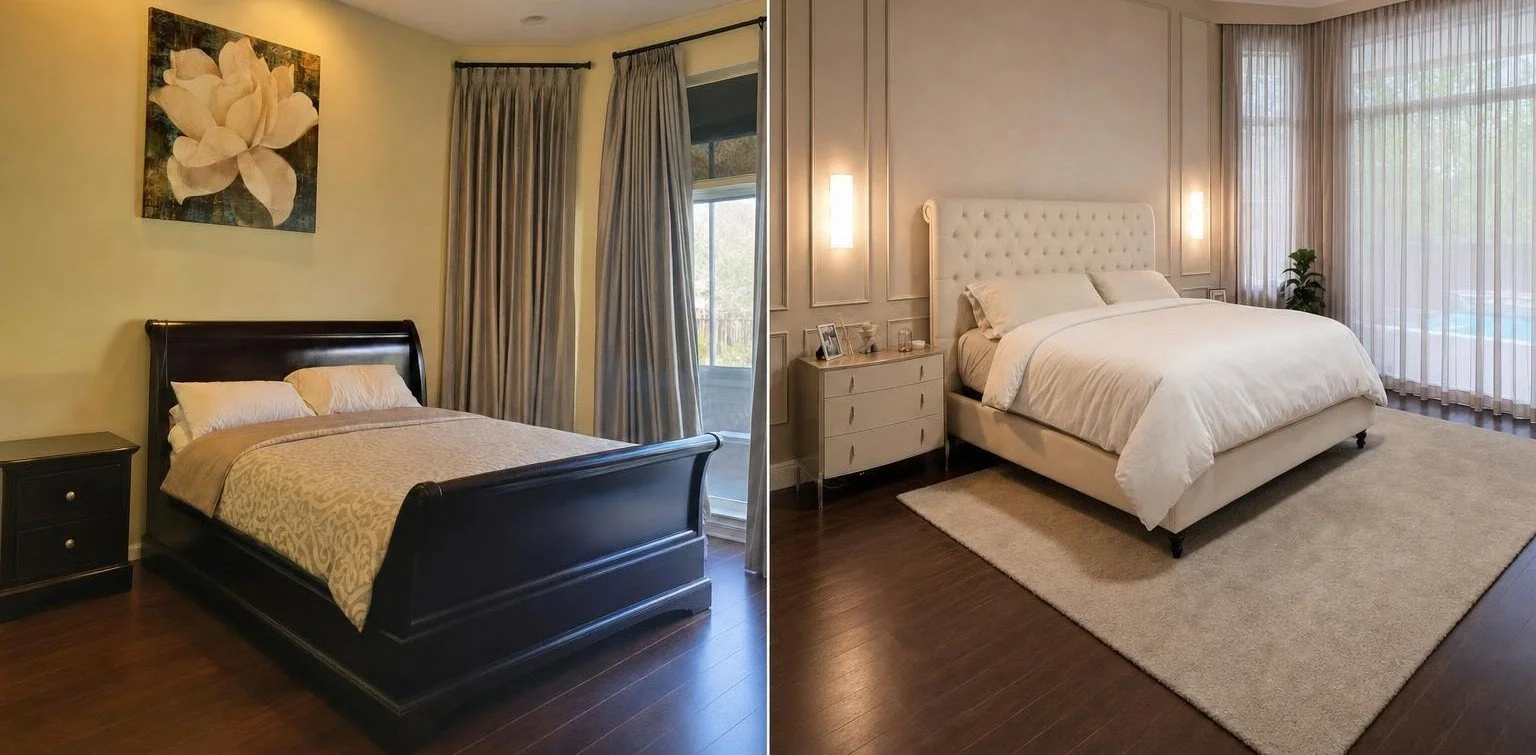
Blackout curtains are a binary solution to a nuanced problem. They block the issue — and the view. Sheer linen panels filter harsh midday glare while preserving the quality of South Florida light: warm, luminous, atmospheric. The difference is the difference between blocking and diffusing.
In our recent Coral Springs master bedroom transformation, we replaced heavy espresso-toned drapes with floor-to-ceiling sheer linen panels on a curved track arching away from the glass at ceiling height. The room didn’t get darker — it got more sophisticated. The pool view, previously buried behind fabric, became the focal point it was always meant to be.
2. Let White Work
Benjamin Moore Simply White — and its near-cousins in the OC and White Dove family — are the workhorse palettes of South Florida interiors for a reason. Warm white reflects the region’s golden-hour light back into the room rather than absorbing and re-radiating it as heat. Paired with architectural detail like wall panel moulding or deep trim, a Simply White room reads as intentional and elevated, not plain.
This is what we mean when we talk about bouncing light. The goal is not to reduce the light. The goal is to distribute it throughout the room so no single wall or corner is overworked.
3. Design by Solar Arc
Florida’s sun arc means morning light enters from the east and evening light from the west — predictably, seasonally consistent. A room that faces east will be luminous and energising at 8am and soft by 3pm. A west-facing room inverts that rhythm entirely.
Design your primary seating, reading nooks, and task areas around that arc rather than against it. Most furniture arrangements ignore solar movement entirely. The families who genuinely love their homes are the ones who happen to sit exactly where the light is doing something beautiful at the time they’re most likely to use that space.
4. Layer Artificial Light for the Evening Transition
South Florida’s evenings shift fast — from golden hour to full dark in under an hour. A room lit only by a central overhead fixture will feel institutional the moment natural light drops. The solution is layered artificial lighting: ambient (recessed or ceiling), accent (wall sconces, picture lights), and task (table and floor lamps), each on a separate dimmer.
When we design lighting plans for Parkland and Coral Springs homes, we’re designing two rooms: the room at 10am and the room at 8pm. Both should feel considered, curated, and consistent with the home’s character.
5. Blur the Indoor-Outdoor Threshold
The most climate-literate South Florida homes don’t resist the outdoor environment — they incorporate it. Zero-threshold sliders, continuous flooring from interior to lanai, exterior shading structures that create a sheltered transition zone: these elements let you manage light and heat at the point of entry rather than deep inside the home.
This doesn’t require a renovation. A pergola with climbing plants, exterior shade sails, or even a well-placed oversized planter can change the light character of an adjacent interior room significantly. Start outside to solve problems inside.
The Result
A home designed to work with Florida’s light rather than against it is a home that’s used fully — every room, every hour of the day, every season of the year. That’s what we build at Krissy Rey Design: spaces that perform as beautifully at 2pm in August as they do at 7pm in January.
If you’ve been making peace with rooms you avoid, views you’ve blocked, or a house that only feels right at certain times of day — it’s a design problem. And design problems have solutions.
Schedule your $350 design consultation — credited in full toward your project.
Krissy Rey Design specializes in bespoke residential interior design for families and professionals in Parkland, Coral Springs, and Delray Beach, FL. Serving the greater South Florida area.