Designed to Last: A Thoughtful Approach to Sustainable Interiors in South Florida
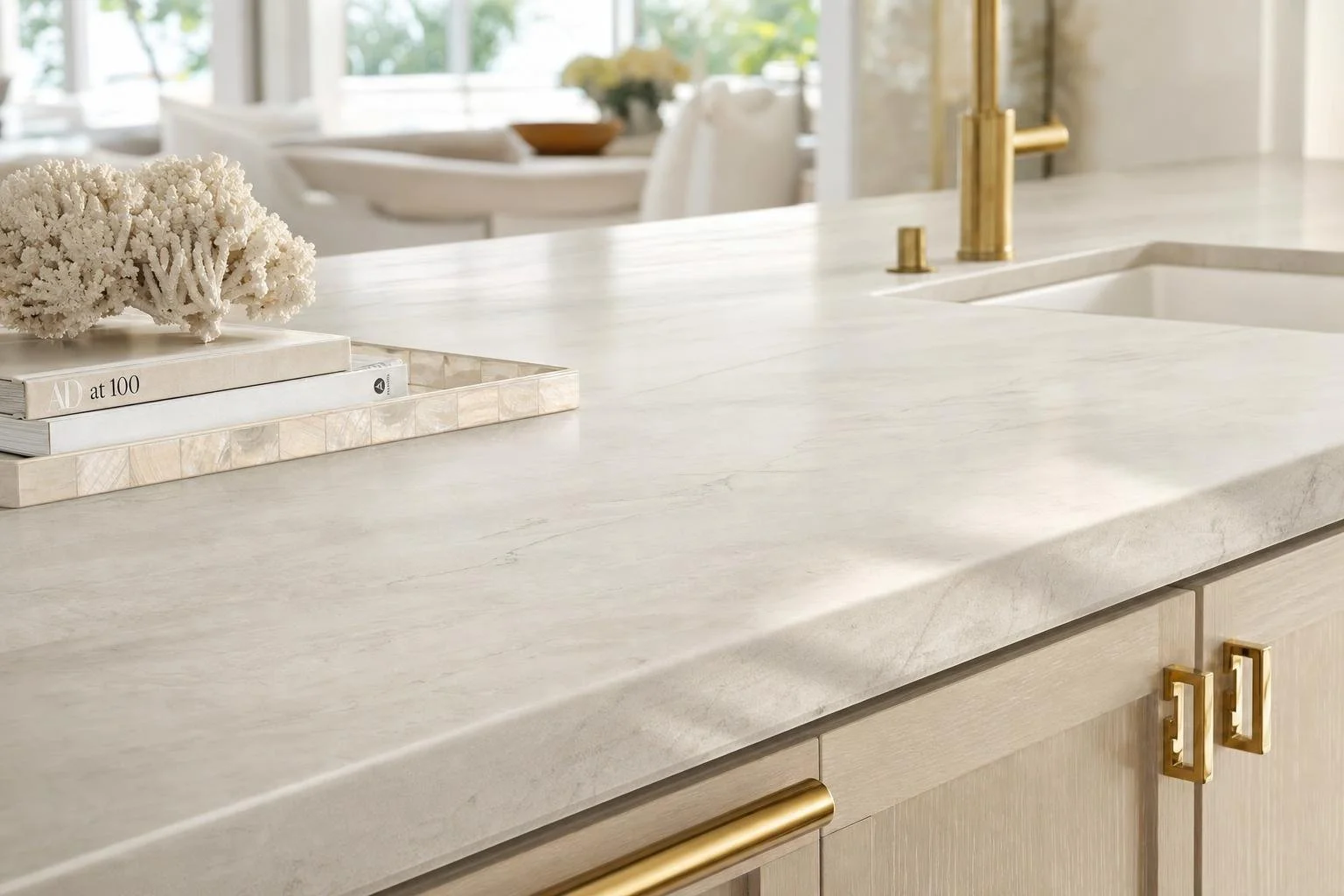
There is a version of sustainability that lives in trend reports — the one with reclaimed barn wood feature walls and Edison bulbs. And then there is the kind that quietly defines every decision made in a well-designed home: the countertop that will never need replacing, the sofa frame that outlasts three fabric changes, the veneer credenza that looks as considered in 2040 as it does today.
At Krissy Rey Design, sustainability is not a trend we follow. It is the architecture beneath everything we specify. For the families we work with in Parkland, Coral Springs, and Delray Beach, it means investing in a home that performs beautifully — for how you actually live — without the cycle of replacement that quietly erodes both quality of life and budget.
This is what genuinely sustainable design looks like in practice.
Materials Built for the Long Game
South Florida interiors live hard. Humidity, UV exposure, the daily reality of active families — these are not design afterthoughts. They are the starting conditions.
The most sustainable specification is always the one that does not need to be replaced.
Stone and concrete that are honed in place are among the most enduring investments in any kitchen or bathroom. Rather than prefabricated slabs installed with visible seams and varying thickness, honing in place means the stone is ground and finished on-site to exact level. The result is a seamless, monolithic surface that eliminates the micro-ridges where moisture and bacteria accumulate — and one that can be re-honed decades later rather than replaced. For Parkland and Coral Springs kitchens where families cook daily and surfaces take genuine wear, this specification is both practical and exceptional.
Solid hardwood versus veneer is a conversation worth having honestly. Solid wood carries emotional weight, but quality veneer — particularly in case goods — is often the more considered choice. A well-constructed veneer piece uses a stable engineered core that is inherently more resistant to South Florida's humidity-driven expansion and contraction. The veneer face, sliced from exceptional figured wood, reveals grain patterns impossible to achieve in solid form. For dining tables, a solid top remains appropriate. For case goods — credenzas, media consoles, bedroom storage — a furniture-grade veneer with dovetailed solid wood drawers and full-extension hardware is not a compromise. It is precision cabinetmaking.
The key distinction is construction quality, not material category. A poorly built solid wood piece will rack, warp, and fail. A thoughtfully engineered veneer piece will outlast it by decades.
Responsible Sourcing: Who You Buy From Matters
Every material has a supply chain. The most durable interior is also, quietly, the most accountable one.
When we specify fabrics, stone, cabinetry, and finishes for our clients, vendor sourcing practices are part of the evaluation criteria — not an afterthought.
We prioritize vendors whose practices include:
FSC-certified wood products — ensuring timber is harvested from responsibly managed forests, not clear-cut operations
GREENGUARD Gold certified textiles and finishes — particularly important for Parkland and Coral Springs families with young children, as this certification verifies low chemical emissions in indoor environments
Domestic and regional fabricators where possible — shorter supply chains mean lower embodied carbon, faster lead times, and direct accountability
Stone sourced from quarries with documented labor and environmental standards — an area where the specification process often goes unasked
This is not about performative virtue. It is about building a home whose materials you can feel genuinely good about — and that reflect the same intentionality you bring to the rest of your life.
Low-VOC Finishes and Certified Products
The air inside a home is often two to five times more polluted than outdoor air, according to EPA data — and the finishing materials applied during construction and renovation are a primary source.
Volatile organic compounds (VOCs) off-gas from paints, stains, adhesives, sealers, and cabinetry finishes. The off-gassing is most intense in the first weeks and months after installation — exactly when a family moves back in.
At KRD, all paint specifications default to zero or low-VOC formulations from lines that do not sacrifice coverage, depth, or durability for cleaner chemistry. Benjamin Moore's Natura and Aura lines, as well as Sherwin-Williams Harmony, deliver the full color range and washability our South Florida clients expect without the chemical burden.
For cabinetry, we specify CARB2-compliant or NAUF (No Added Urea Formaldehyde) cores as a standard — not an upgrade. For stone sealers, we select water-based penetrating formulations over solvent-based topical coatings. For adhesives and caulks, low-VOC alternatives are available across every application category.
This matters especially in homes with children and in the sealed, air-conditioned environments that characterize South Florida living, where indoor air is recirculated rather than naturally ventilated.
Pieces That Outlive Trends
The most unsustainable thing a home can do is become dated.
Fast-follow trend furniture — the mass-produced versions of whatever debuted at Salone del Mobile two years prior — has a shelf life measured in seasons, not decades. It is also, almost universally, constructed to that expectation. Thin veneers over MDF cores, staple-and-glue frames, hardware that loosens within two years of daily use.
The counterpoint is not "buy everything antique." It is about developing the eye for pieces with inherent design longevity — forms rooted in proportion and material rather than in trend language.
In our work across Parkland and Delray Beach, the pieces that age most gracefully share a few consistent qualities:
Clean, geometric silhouettes that read as modern in any decade — not reactionary to a specific moment
Natural materials that patina rather than degrade — solid brass that deepens, leather that softens, linen that drapes more beautifully with washing
Scale proportioned to the architecture, not to a trend moment's preference for oversize or minimal
Hardware and joinery that can be serviced — drawers that can be re-glided, hinges that can be replaced, upholstery that can be redone
These are not qualities exclusive to heirloom price points. They are design criteria applied at every investment level.
The Case for Vintage Case Goods
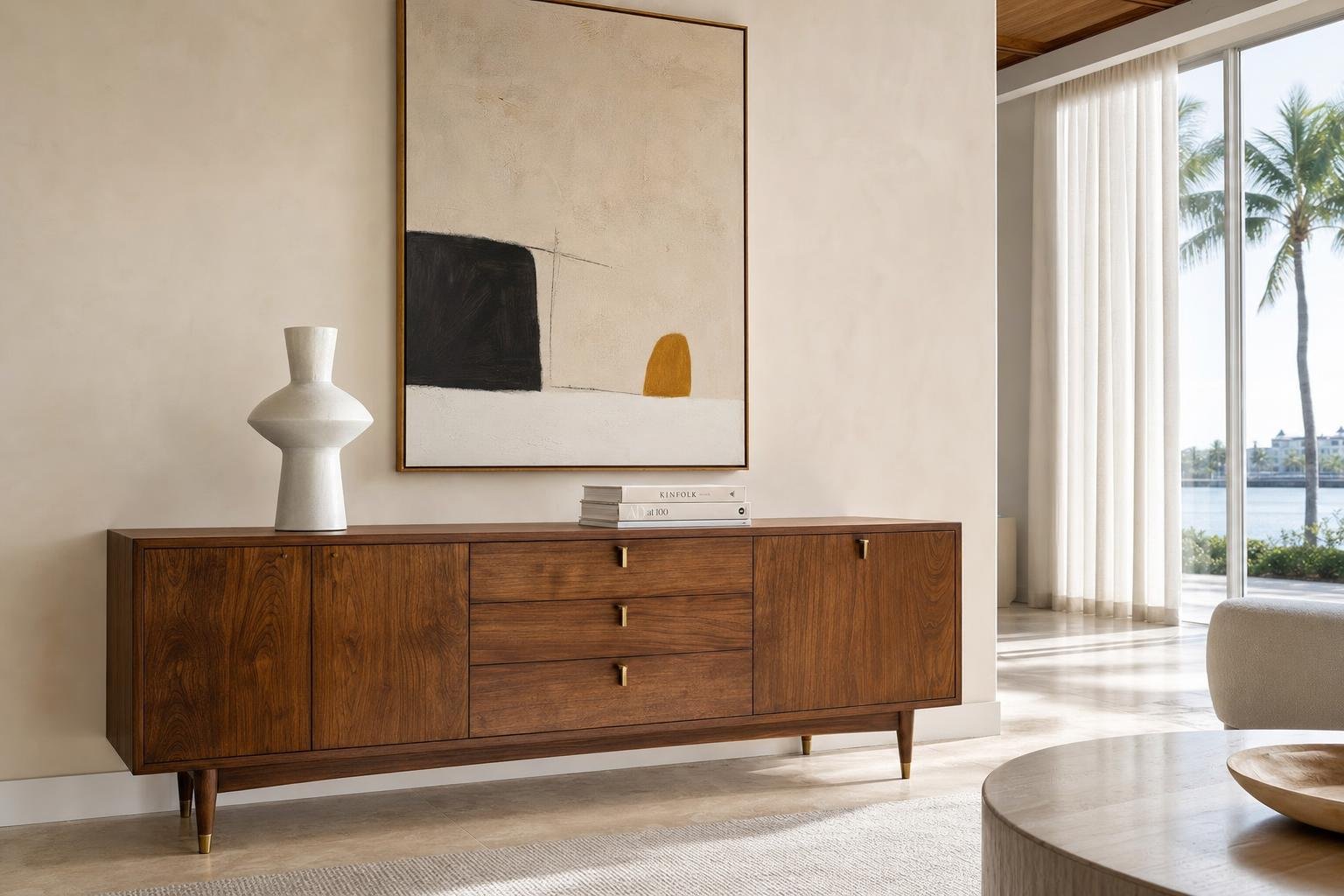
There is no more sustainable furniture specification than a vintage piece of exceptional construction.
Mid-century American and Scandinavian case goods — credenzas, bedroom dressers, dining consoles — represent some of the finest furniture production in the 20th century. Solid walnut, teak, and rosewood with hand-cut dovetail joinery, solid brass hardware, and tapered legs that remain as proportionally precise today as they were in 1962. These pieces were built before planned obsolescence was a manufacturing philosophy.
Sourcing vintage case goods for our clients in Delray Beach and Parkland allows us to:
Eliminate the embodied carbon cost of manufacturing a new piece
Introduce genuine material quality — solid walnut with decades of patina — at a fraction of the cost of equivalent new production
Anchor a room with irreplaceable character that no production line can replicate
Our guidance for integrating vintage: let one or two key pieces — typically the largest horizontal surface in a room — be vintage. The credenza, the dresser, the dining sideboard. Build the remaining specification around them in complementary tones and forms. The result reads as curated rather than collected, and the vintage anchor elevates everything around it.
Reupholstering: The Most Overlooked Investment
If you have a sofa with an exceptional frame — eight-way hand-tied springs, kiln-dried hardwood construction, deep seat depth — reupholstering it is almost always the correct decision.
The frame is the investment. Fabric is a finish.
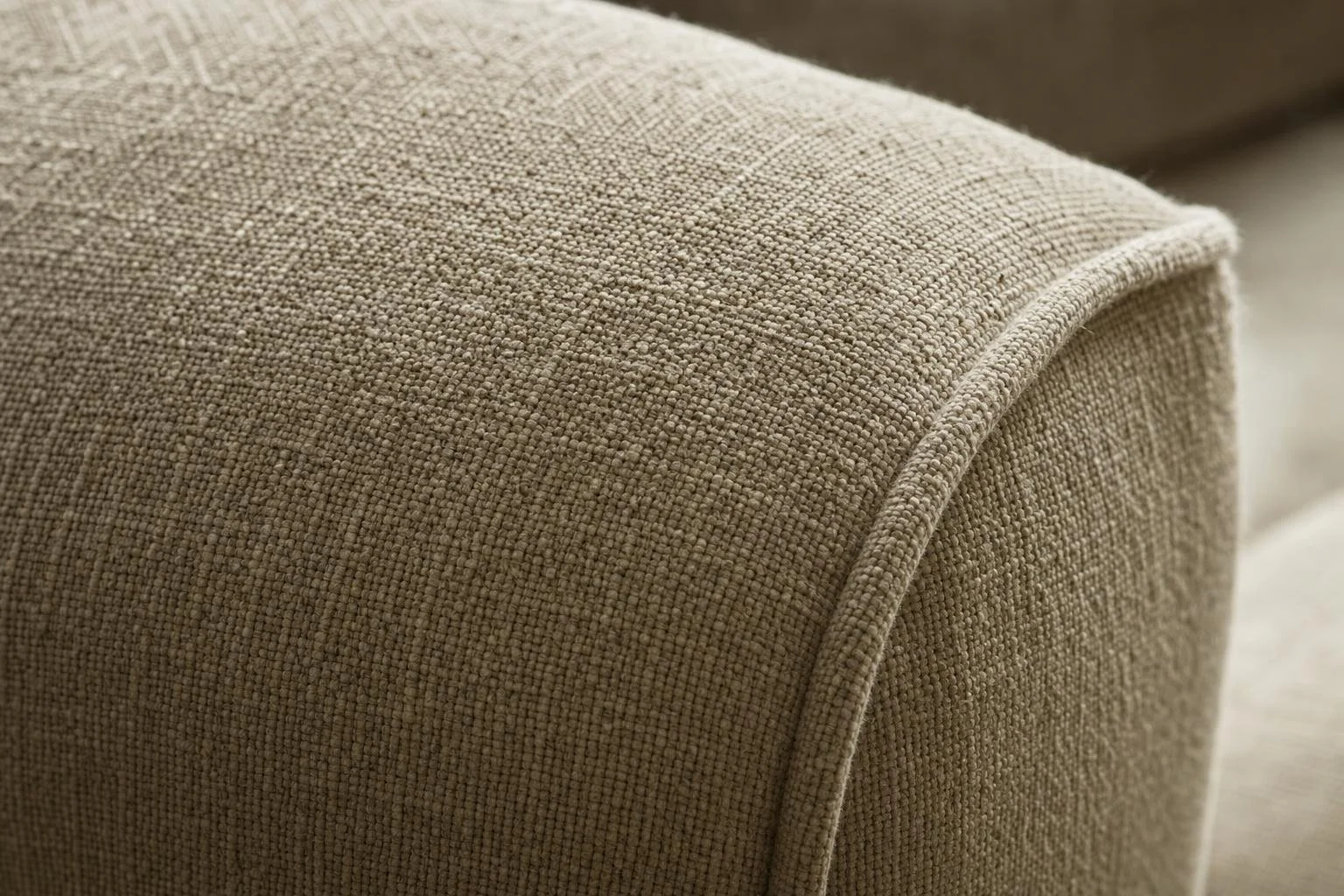
For Coral Springs and Parkland families whose sofas have seen years of daily use, reupholstering with a performance-grade fabric — a high-rub-count solution-dyed acrylic or a tight-woven Belgian linen blend — delivers a like-new piece at 40–60% of replacement cost, with zero compromise in comfort and a dramatic improvement in longevity.
The fabrics available through the design trade for reupholstery work are categorically different from retail furniture fabrics. We specify by double-rub count (a measure of abrasion resistance), fiber content, and cleaning code as standard — ensuring that the fabric selected for a family room sectional will genuinely perform for the next decade of South Florida living.
A piece worth reupholstering will have:
Consistent cushion rebound after sitting (not bottoming out)
No frame flex when weight is applied to corners
Tight, even seam construction — not puckered or pulling
If the frame is good, the piece is worth saving. We make that evaluation as part of every design process.
Sustainability as a Standard, Not a Feature
The most durable, sustainable home is also the most beautiful one — because it was designed from the beginning with material honesty, long-term performance, and genuine craft at its foundation.
For the families we work with across Parkland, Coral Springs, and Delray Beach, this approach means fewer decisions over time, not more. It means a home that deepens in character rather than dating. And it means an investment that performs — visually and functionally — for as long as you live in it.
If you are ready to approach your next project with this level of intention, we would love to talk.
Schedule a Complimentary Discovery Call
Krissy Rey Design serves residential clients throughout Parkland, Coral Springs, and Delray Beach. Our full-service process handles material sourcing, vendor vetting, and project management — so the experience is as seamless as the result.